
Today, Chancellor Rishi Sunak delivered the first Budget of the new decade, setting out the Government’s plans to invest heavily in infrastructure, boost housing supply and support economic growth across the UK. The Budget was presented on 11 March 2020 and marked the Chancellor’s first Budget since taking office.
For landlords, property investors and housing professionals, Budget 2020 signals a renewed focus on construction, regeneration and economic investment. While there were no dramatic changes to landlord taxation, a number of announcements could have significant implications for housing markets over the coming years.
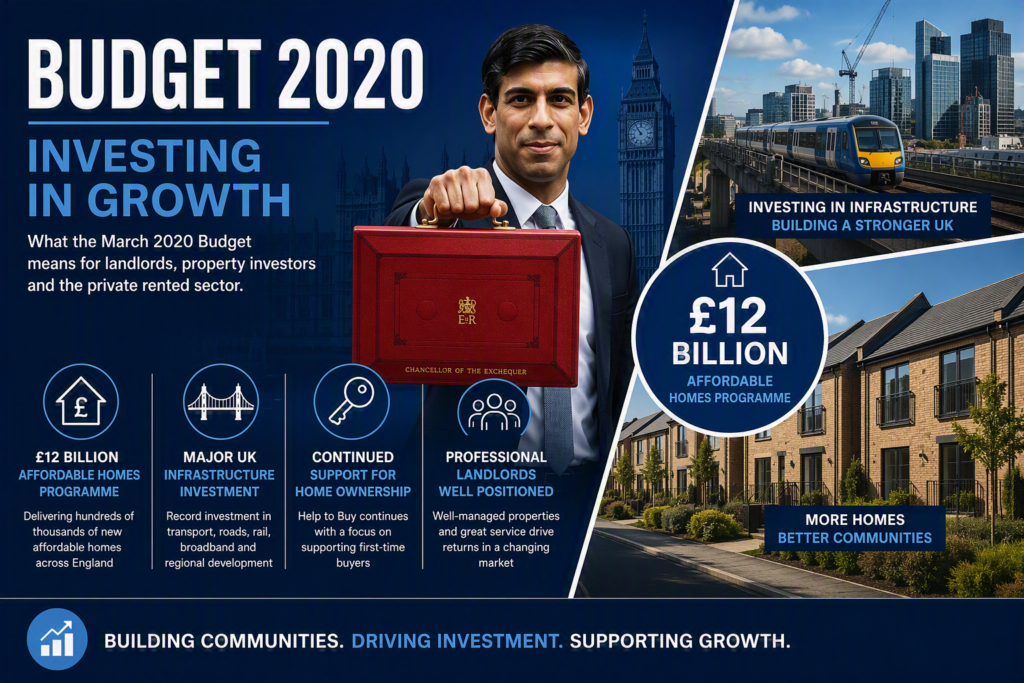
The Headline: A £12 Billion Affordable Homes Programme
The Government announced a new £12 billion Affordable Homes Programme, representing one of the largest commitments to affordable housing in a generation.
The programme is intended to support the delivery of hundreds of thousands of new homes across England and forms a central pillar of the Government’s ambition to increase housing supply. Housing delivery is increasingly being viewed as both an economic and social priority.
For landlords and investors, continued investment in housing supply should help meet growing demand while supporting wider market stability.
A Record Commitment to Infrastructure
A key theme of the Chancellor’s statement was investment.
The Government announced significant spending on transport, roads, rail infrastructure, broadband and regional development, with a clear focus on economic growth and levelling up communities across the country.
Historically, major infrastructure investment has often created opportunities for property markets by improving connectivity, attracting employers and supporting regeneration initiatives.
For property investors, infrastructure projects frequently become important indicators of future market growth, rental demand and tenant mobility.
Help to Buy Continues
The Government confirmed the continuation of Help to Buy, although reforms are planned to focus the scheme increasingly towards first-time buyers.
The continued support for aspiring homeowners reinforces the long-standing Government objective of improving access to home ownership while encouraging the construction of new homes.
For developers, this provides additional certainty and confidence to continue investment in residential construction.
Planning and Housing Delivery
One of the clearest messages from Budget 2020 is the Government’s determination to build more homes.
Alongside affordable housing funding, the Chancellor outlined a range of measures intended to increase development activity, support local infrastructure and accelerate housing delivery in areas of strong demand.
The Government remains committed to increasing annual housing output significantly over the coming years.
What Does This Mean for Landlords?
Perhaps the most notable aspect of Budget 2020 for landlords is what was not announced.
There were no significant new taxes targeting residential landlords and no further major restrictions on private property investment announced in the Budget itself.
This may be welcomed by landlords following several years of substantial tax and regulatory reform.
However, landlords continue to operate in a market shaped by:
- The 3% Stamp Duty surcharge on additional properties.
- Mortgage interest tax relief reforms.
- Growing regulatory requirements.
- Increased tenant expectations.
- Higher compliance standards.
The challenge therefore remains the same: delivering strong returns through better management rather than relying purely on capital growth.
The Rise of Professional Operators
The private rented sector continues to evolve.
As regulations become more complex and tenant expectations increase, landlords are increasingly recognising the value of professional management, efficient systems and specialist expertise.
The most successful operators are focusing on:
- Occupancy optimisation.
- Tenant satisfaction.
- Compliance management.
- Planned maintenance.
- Operational efficiency.
- Sustainable portfolio growth.
This trend is particularly evident within HMO and co-living sectors where service and operational standards can have a direct impact on performance.
A Positive Outlook for Housing
Despite wider economic uncertainty, the Government’s commitment to housing, infrastructure and investment sends a positive signal for the long-term property market.
Strong population growth, affordability challenges and changing lifestyle choices continue to support demand for rented accommodation across many parts of the country.
Even with increased housing delivery, professionally managed rental homes will remain an essential part of the UK’s housing ecosystem.
Looking Ahead
Budget 2020 highlights three important themes:
- Building More Homes
The Government is committing significant funding towards affordable and new housing delivery.
- Investing in Places
Infrastructure spending is intended to drive economic growth and improve connectivity across the UK.
- Professional Management Matters
As the housing market becomes increasingly sophisticated, landlords who focus on operational excellence, compliance and service quality are likely to outperform.
The ROOMS® View
At ROOMS®, we welcome the Government’s commitment to housing and infrastructure.
More homes, better infrastructure and stronger local economies ultimately benefit tenants, landlords and communities alike.
However, delivering housing is only part of the challenge. The quality of accommodation, tenant experience and day-to-day management remain critical.
We believe the future belongs to professional operators who combine great homes, strong systems and exceptional customer service.
As government investment accelerates housing delivery, the opportunity for professional landlords and co-living providers continues to grow.
The next decade will not be defined simply by who owns property, but by who manages it best.