
Today, Chancellor Rishi Sunak delivered the 2021 Spring Budget against the backdrop of the COVID-19 pandemic and the UK’s economic recovery. Describing it as a Budget that would “protect the jobs and livelihoods of the British people”, the Chancellor set out a three-part plan focused on support, recovery and future growth. [gov.uk]
For landlords, property investors and housing professionals, this Budget is one of the most significant in recent years. With measures designed to keep the housing market moving, support home ownership and stimulate economic activity, it is likely to influence property markets well beyond 2021. [gov.uk], [standard.co.uk]
The Headline: The Stamp Duty Holiday Extended
The biggest property announcement was the extension of the Stamp Duty holiday.
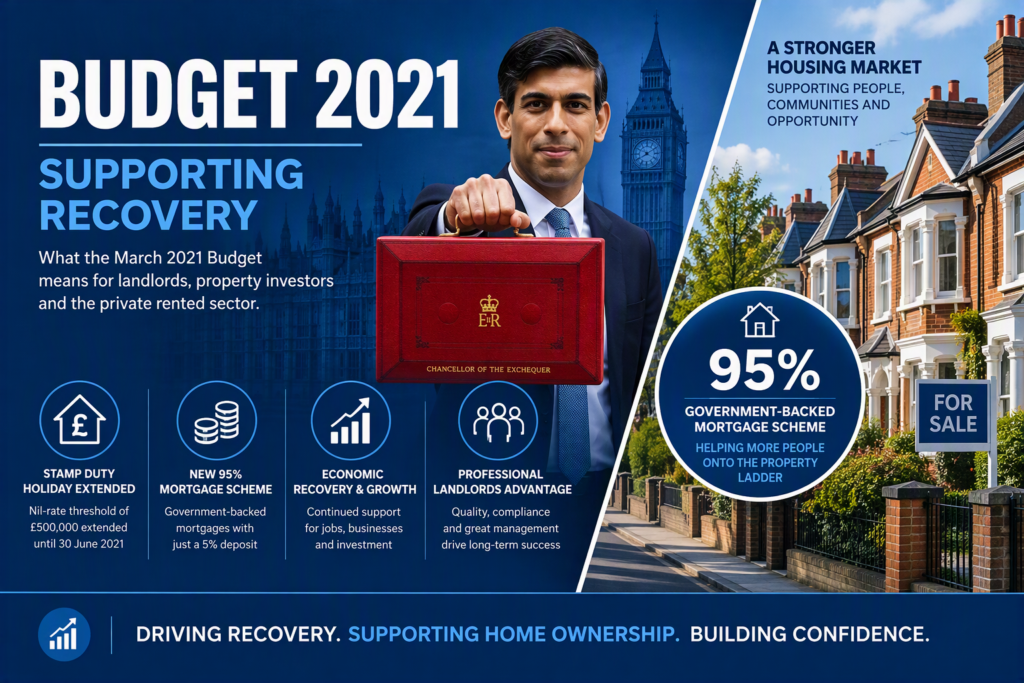
The Chancellor confirmed that the temporary nil-rate threshold of £500,000 would be extended until 30 June 2021, before tapering to £250,000 until the end of September. The previous threshold of £125,000 would return from October. [standard.co.uk], [bdcmagazine.com]
The extension was welcomed across the property industry and was intended to prevent a sudden slowdown in property transactions as buyers and sellers worked through significant conveyancing backlogs. [standard.co.uk]
For many purchasers, the extension represented a potential saving of up to £15,000. [standard.co.uk]
A New 95% Mortgage Guarantee Scheme
Alongside the Stamp Duty extension, the Government announced a new Mortgage Guarantee Scheme to encourage lenders to offer 95% loan-to-value mortgages.
The initiative was designed to help buyers purchase homes with deposits as low as 5%, supporting both first-time buyers and existing homeowners purchasingproperties up to £600,000. [bdcmagazine.com], [insidehousing.co.uk]
The return of low-deposit mortgages marks one of the most significant interventions in support of home ownership since Help to Buy and reflects the Government’s desire to maintain momentum within the housing market.
Supporting Recovery Through Investment
The wider Budget focused heavily on economic recovery following the pandemic.
The Government announced continued support for businesses and workers, with substantial measures aimed at protecting jobs, encouraging investment and supporting growth as restrictions eased. Rishi Sunak stated that over £280 billion of support had already been provided during the pandemic. [gov.uk]
The Chancellor also emphasised that the Government would begin investing in the future economy while supporting recovery in the short term. [gov.uk]
What Does This Mean for House Prices?
The combination of the extended Stamp Duty holiday and the mortgage guarantee scheme is likely to continue supporting buyer demand throughout much of 2021.
The housing market has remained remarkably resilient during the pandemic, driven by changing lifestyle priorities, record-low borrowing costs and increased demand for larger homes and more flexible living arrangements. This context was widely discussed following the Budget announcements. [standard.co.uk], [bdcmagazine.com]
While strong demand may support house prices in the short term, landlords and investors should remain focused on sustainable rental demand and cash flow rather than relying solely on capital growth.
Landlords Remain in a More Challenging Tax Environment
Although the Budget delivered significant support for homeowners and buyers, there were no major tax reductions targeted specifically at residential landlords.
Investors continue to operate within a market shaped by:
- The 3% Stamp Duty surcharge on additional properties.
- Mortgage interest tax changes implemented in previous years.
- Increasing compliance requirements.
- Rising standards and tenant expectations.
As a result, operational performance remains more important than ever.
Professional Management Creates Competitive Advantage
The pandemic has accelerated changes already taking place within the private rented sector.
Tenants increasingly expect:
- Faster communication.
- Better maintenance standards.
- Greater flexibility.
- Digital systems and processes.
- High-quality accommodation.
At the same time, landlords are becoming increasingly aware of the value created through professional management and specialist operational expertise.
For HMO, co-living and shared accommodation providers, strong systems and customer experience are becoming key differentiators.
The Private Rented Sector Still Matters
While much of today’s Budget focused on home ownership, the reality remains that millions of people will continue to rent.
Affordability constraints, lifestyle choices, employment mobility and personal circumstances mean that professionally managed rented accommodation continues to play a vital role within the housing market.
Even as more people access low-deposit mortgages, demand for quality rental accommodation remains significant.
Looking Ahead
Budget 2021 signals four key themes:
- Supporting Housing Transactions
The Stamp Duty holiday extension is designed to keep the housing market moving. [standard.co.uk], [bdcmagazine.com]
- Making Home Ownership More Accessible
The Mortgage Guarantee Scheme aims to help buyers purchase homes with just a 5% deposit. [bdcmagazine.com], [insidehousing.co.uk]
- Driving Economic Recovery
The wider Budget is focused on supporting jobs, investment and growth following the pandemic. [gov.uk], [gov.uk]
- Rewarding Professional Operators
In an increasingly competitive market, the landlords who prioritise service, systems and tenant experience are likely to achieve the strongest long-term results.
The ROOMS® View
At ROOMS®, we welcome measures that support confidence in the housing market and help people move home.
However, today’s announcements also highlight an important reality: property success is increasingly about operational excellence rather than simply ownership.
Whether the market is rising or falling, the fundamentals remain unchanged. Great homes, professional management, responsive service and strong tenant relationships continue to drive sustainable performance.
As the UK emerges from the challenges of the pandemic, we believe the strongest opportunities will belong to operators who combine high-quality accommodation with exceptional customer experience.
Recovery creates opportunity. Professionalism turns opportunity into long-term success.