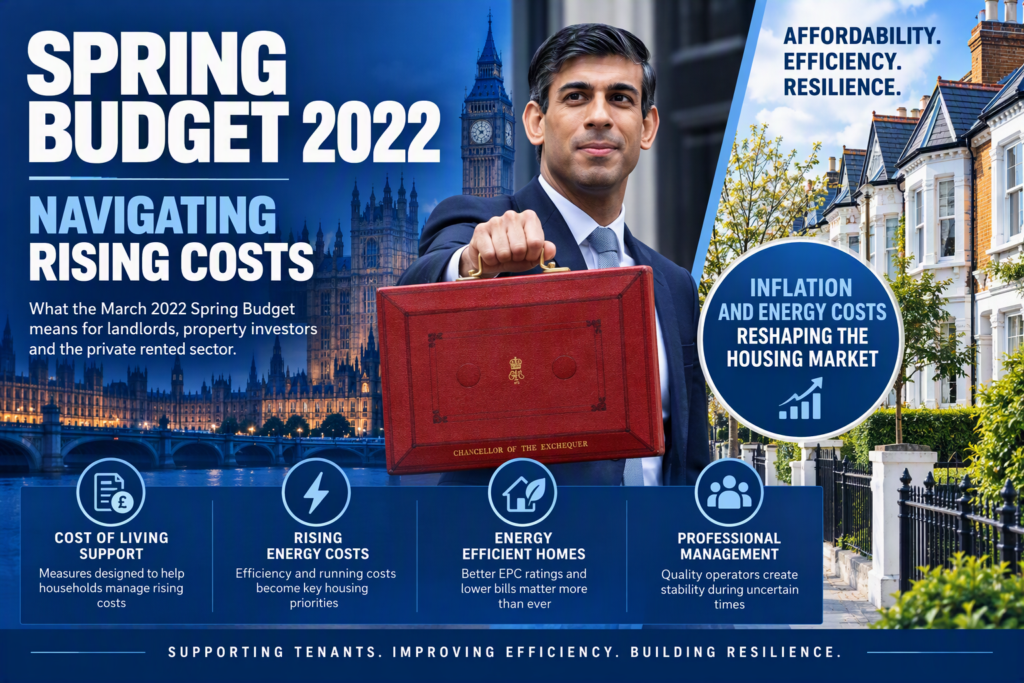

Today, Chancellor Rishi Sunak delivered the Spring Statement 2022 against a backdrop of rising inflation, increasing energy costs and growing pressure on household finances. While this was not a full Budget, it contained important measures that will influence landlords, tenants and the wider housing market.
Unlike previous Budgets that focused heavily on housing delivery and home ownership, the Spring Statement was largely shaped by the cost-of-living challenge facing households across the UK.
For landlords, the message is clear: tenant affordability, energy efficiency and operational efficiency are becoming increasingly important considerations in maintaining sustainable rental businesses.
The Headline: Tackling the Cost of Living
The Chancellor’s primary focus was helping households manage rising living costs.
Inflation had risen significantly, energy prices were increasing rapidly and many renters and homeowners were feeling the impact on monthly budgets. The Spring Statement introduced a range of tax and income measures designed to leave more money in people’s pockets and support economic resilience.
For the property sector, this matters because affordability remains one of the most important drivers of rental performance.
Landlords whose properties remain affordable to heat, maintain and occupy are likely to be better positioned than those whose tenants are exposed to rising household costs.
Rising Energy Costs Become a Property Issue
For perhaps the first time, energy performance moved from being primarily an environmental topic to becoming a major economic issue for housing providers.
With gas and electricity costs increasing sharply, tenants are becoming more conscious of:
- Energy-efficient homes.
- Modern heating systems.
- Quality insulation.
- Lower utility bills.
- EPC ratings.
For landlords, this reinforces a trend that has been developing for several years.
Properties that are cheaper to run may attract stronger tenant demand, achieve higher retention rates and become increasingly resilient to changing legislation.
Pressure on Rental Affordability
The Spring Statement arrives at a time when many households are facing multiple cost increases simultaneously.
Rising utility costs, fuel prices and general inflation create affordability challenges for tenants, particularly in urban areas and among younger renters.
Professional landlords and operators are therefore increasingly focused on:
- Minimising void periods.
- Supporting long-term tenancies.
- Delivering value for money.
- Improving communication with residents.
- Maintaining high occupancy levels.
The most successful operators are likely to be those who balance commercial performance with tenant affordability.
Housing Supply Remains a Long-Term Challenge
Although housing was not the dominant focus of the Spring Statement, the UK’s housing shortage remains unchanged.
Demand for rental accommodation continues to exceed supply in many locations, helping support occupancy rates and rental demand.
However, affordability constraints are becoming a larger influence on tenant decision-making than simple availability.
Increasingly, renters are looking for homes that offer:
- Predictable costs.
- Convenient locations.
- Flexible living arrangements.
- Professional management.
- Good value relative to alternatives.
This dynamic continues to support high-quality shared accommodation and co-living models.
Professional Management Creates Stability
Periods of economic uncertainty often highlight the difference between passive ownership and active management.
Professional operators are generally better placed to:
- Monitor arrears.
- Manage maintenance efficiently.
- Communicate effectively with tenants.
- Control operating costs.
- Protect long-term occupancy.
The operational side of property management has never been more important.
For HMO and co-living operators, systems, communication and customer experience are becoming powerful differentiators.
A Changing Market for Landlords
While no major landlord tax changes were announced in the Spring Statement, the market continues to evolve.
Investors now face a landscape characterised by:
- Rising inflation.
- Increasing energy costs.
- Greater tenant expectations.
- Higher compliance standards.
- Ongoing housing demand.
As a result, property performance is increasingly driven by management quality rather than simply asset ownership.
The Growing Importance of Sustainability
The combination of higher energy costs and environmental objectives is accelerating the importance of sustainable housing.
Over the coming years, landlords may need to consider:
- EPC improvements.
- Modern heating systems.
- Energy saving measures.
- Better insulation.
- Renewable technologies where appropriate.
What was once considered a future issue is increasingly becoming a commercial necessity.
Looking Ahead
Spring Budget 2022 highlights four important themes:
- Affordability Matters More Than Ever
Households are facing increasing financial pressure, making affordability a central housing issue.
- Energy Efficiency Creates Value
Running costs are becoming a key factor in tenant decision-making.
- Professional Management Drives Performance
Operational excellence remains one of the strongest ways to protect long-term returns.
- Demand for Rental Housing Remains Strong
Despite wider economic challenges, professionally managed rental accommodation continues to play a vital role in the UK housing market.
The ROOMS® View
At ROOMS®, we believe Spring 2022 signals a shift in focus for the property sector.
The conversation is no longer simply about house prices, taxation or building more homes. Increasingly, it is about affordability, sustainability and how effectively homes are managed.
Tenants are looking for more than a place to live. They are looking for value, predictability and support during a period of economic uncertainty.
We believe the landlords who will thrive in this environment are those who focus on operational excellence, proactive communication and continually improving the living experience for residents.
As costs rise, quality management becomes more valuable than ever.
The future belongs to operators who can deliver not only housing, but stability, value and confidence.